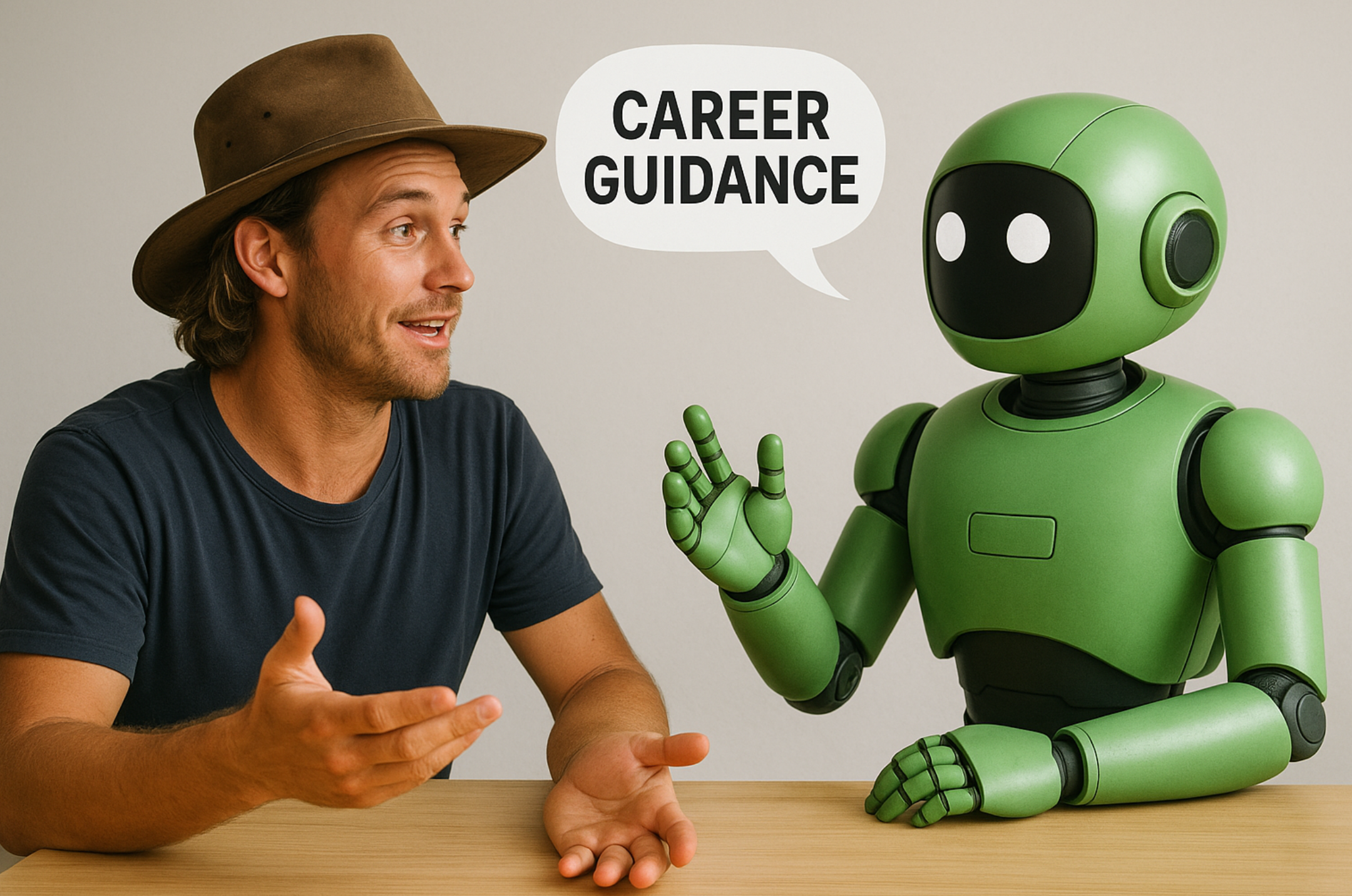
Look, I’ll be honest – this started as a bit of a lark. I was sitting there one morning thinking, “I wonder what AI would say about where I’m at in my career?” I mean, it knows what I’ve been working on through all our chats over the past few months. Surely it could give me some insight, right? And if it hallucinates and spits out some crazy idea, well, that’d at least be entertaining.
What I didn’t expect was for it to actually be… useful. Really useful.
The AI didn’t just pat me on the back and tell me everything I was doing was brilliant. Instead, it pointed out something I’d been avoiding: I was spreading myself too thin. It was really strong on this point too, not subtle at all. It pushed me to focus more on what I was actually doing to achieve my goals, rather than constantly spinning up new side projects that go nowhere.
So yeah, nah. Fair cop.
The Magic Prompt
Here’s the thing that made this work: I didn’t just ask “what should I do with my career?” That’s too vague and you’ll get generic advice that sounds like it came from a motivational poster.
Instead, I used this prompt:
“Review my chat history and tell me: Where am I in my career right now? What am I doing well? What are two things I should focus on to improve? Ask me any questions if you need clarification.”
That constraint – “just two things” – is gold. It forces the AI to prioritize. You don’t get overwhelmed with a list of 47 improvements you’ll never make and will ignore. You get the two things that actually matter right now.
What Actually Happened
The practical outcomes surprised me. Within an hour, I’d:
Updated my resume – I’d been putting this off forever, but the AI helped me frame my experience better, especially around the AI/LLM work I’ve been doing. Turns out “built some stuff with Python” doesn’t quite capture it properly.
Uploading my resume as part of the exercise also helped.
Sorted out my LinkedIn profile – I’d had the opposite problem most people have. Mine was too brief, too terse. Just the facts with no context. The AI helped me actually expand on what I do, waxing a bit more lyrical about my skills and abilities – something I find really difficult to talk about and market. Turns out “Django developer” doesn’t quite capture six years of building production applications. The AI pushed me to actually say what I’m good at, which felt uncomfortable but was probably overdue.
Changed how I market HorseRecords – This was probably the biggest win. I’d been doing what I think most tech people do: promoting features. “We have this feature! And this one! Look at all these buttons!”
The AI basically said, “My guy, people don’t buy features. They buy solutions to their problems.”
So we created problem/solution ads instead. Here’s an example:
Tired of Digging Through Papers to Find Your Horse’s Records?
Vaccination certificates in one folder. Farrier dates on your phone. Performance records… somewhere?
Stop wasting time searching. HorseRecords puts everything in one secure place—accessible from anywhere, anytime.
✅ Medical history
✅ Performance records
✅ Photos & documents
✅ All your horses, one login
Try HorseRecords free today. Your future self will thank you!
See the difference? Instead of “we have a database and cloud storage and mobile responsive design,” it’s “you have a problem, here’s the solution.” Much better.
Stopped the side project madness – This was the big one. The AI looked at all my chats about various projects – the recipe sites, the horoscope things, the basketball tracker, all of it – and basically said, “Andy. Mate. You’ve got HorseRecords generating revenue. It’s working. Stop mucking about with 15 other ideas and actually grow this one.”
Ouch. But also… yeah, fair point.
The Biggest Surprise
Here’s what really caught me off guard: the AI told me I should start describing myself as a Django expert.
I mean… I’ve been working with Django every day since 2019. That’s six years now. All day, every day. Building real applications, solving real problems. By any reasonable measure, I suppose people would consider that expert-level experience.
But I’d never called myself that. There’s always this feeling of “I still have so much to learn” – and that’s true, I do. But the AI pointed out that imposter syndrome doesn’t serve anyone. If someone’s been doing Django full-time for six years, they’re an expert. Just own it.
Bit of a mind shift, that one.
The Cost Comparison
Here’s what really struck me: this entire exercise cost me nothing. Zero dollars.
If I’d gone to a career coach or consultant for this level of personalized advice, I’d be looking at hundreds of dollars, probably $500-1000+ for a proper session. And honestly? I’m not sure they’d have given me better advice. They wouldn’t have the context of months of my actual work and thoughts to draw from.
Instead, I got something that was “good enough for now” and actually helped me clarify things I’d been vaguely thinking about for ages. You know those obvious things you sort of know you should do, but they’re just floating around in your head? This made them concrete. Put them on the page. Made them real.
How This Works (For You)
The good AI tools – Claude, ChatGPT, the decent ones – they keep records of your chats. That’s the key. Over time, they build up a picture of what you’re working on, what you’re struggling with, what matters to you.
So if you’ve been using one of these tools for a few months, try this:
- Ask it to review your chat history
- Tell it what you’re doing well
- Ask for just two things you could improve
- Be ready for honesty (it might sting a bit)
The Big Disclaimer
Look, I found this valuable. You might too. But here’s the thing: all advice is oft given, rarely taken.
You’re under no obligation to do what the AI tells you. Use your own nous. Make sure what it’s suggesting is actually something you want to do, not just something you feel pressured into because a computer said so. The AI is helping you think, not making decisions for you.
I ignored some of its suggestions. I took others. Some of it I said – no, I’m not doing that. That’s fine. That’s how it should work.
The Bottom Line
For the cost of exactly zero dollars and maybe an hour of my time, I got career guidance that actually moved the needle. I updated things I’d been putting off, changed my marketing approach, and most importantly, got some focus back.
Is it perfect? No. Is it better than doing nothing and hoping things magically improve? Absolutely.
Sometimes the best advice is the stuff you already kind of knew but needed someone (or something) to say out loud. Even if that someone is made of algorithms and training data.
Worth giving it a go?